
Key-Value Store Project
Part 2 of 2

Saving the key-value store to disk
Saving data to disk is a bit like the shift a startup makes from a neat idea scribbled on a napkin to a service people depend on every day. Suddenly, longevity matters, and every detail must be meticulously recorded and retrieved to ensure the venture's resilience against the unexpected.
When building a key-value store in Rust, we eventually face a core milestone: giving our in-memory store permanence by writing it to disk. This requires turning our ephemeral data into a format that can weather power outages and reboots, much like how a company's culture might preserve its mission through leadership changes and market storms.
Rust is well-equipped for this job, offering robust file I/O capabilities that let us store and read our data from disk, and serialization libraries like `serde` to convert our data from Rust structs into a storable format—a process we call serialization—and back again when needed, known as deserialization.
The choice of format—whether JSON for its human readability, binary for its compactness, or CSV for simplicity—depends on the needs of the store. Let's choose JSON for our purposes, given its ubiquity and balance between size and accessibility.
Here's how we'd define the save function in Rust:
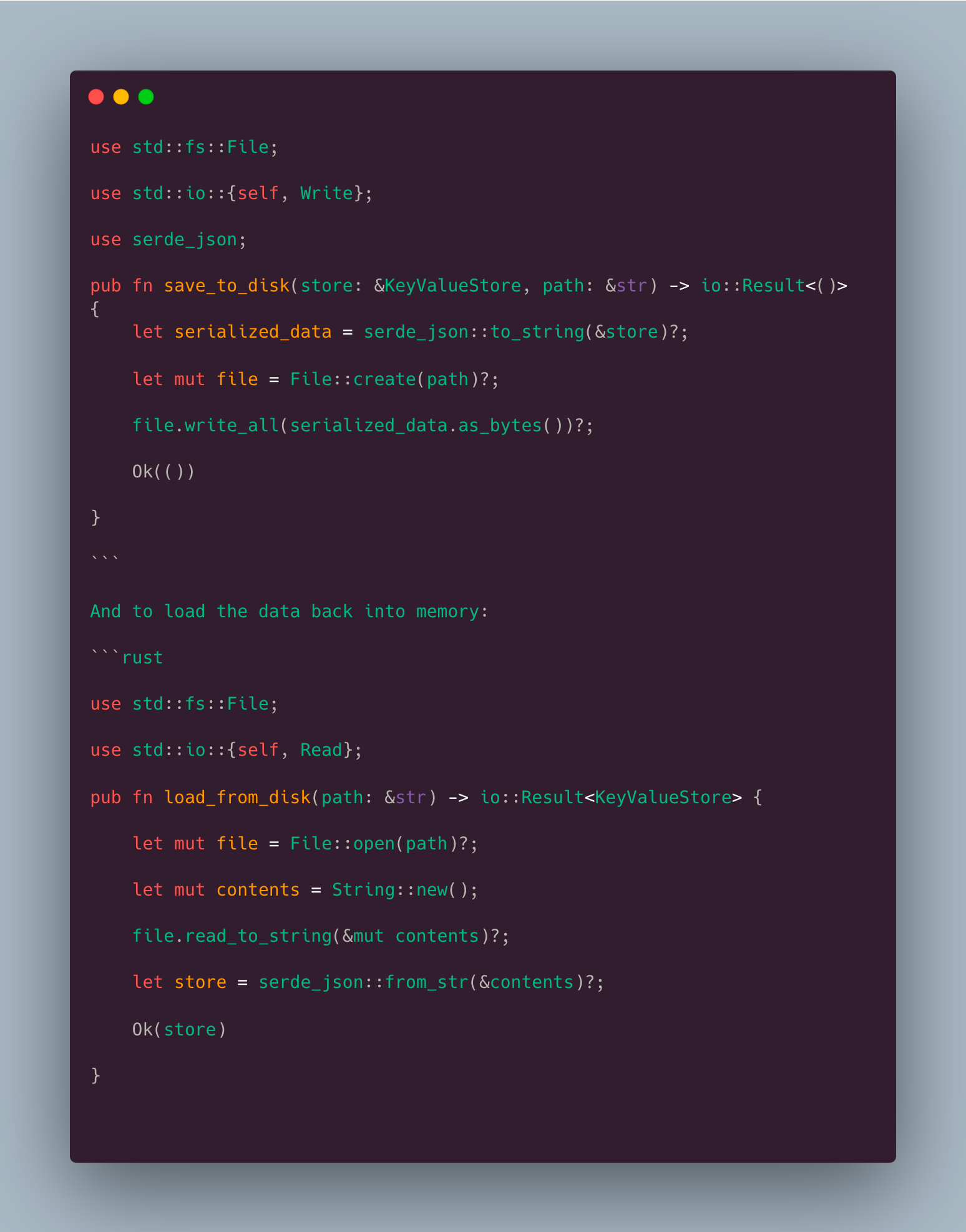
While this idea of persistence is foundational, it's not without potential potholes. I/O operations can fail due to reasons like missing files or permission issues, and data must remain consistent—no corrupted files should lead our key-value store astray.
Therefore, handling I/O errors gracefully and validating data integrity become paramount. Startup equivalents might be regulatory compliance and quality control processes ensuring the business runs smoothly.
Adding a layer of tests fortifies our key-value store against such setbacks, just as robust quality checks might avert a PR disaster:
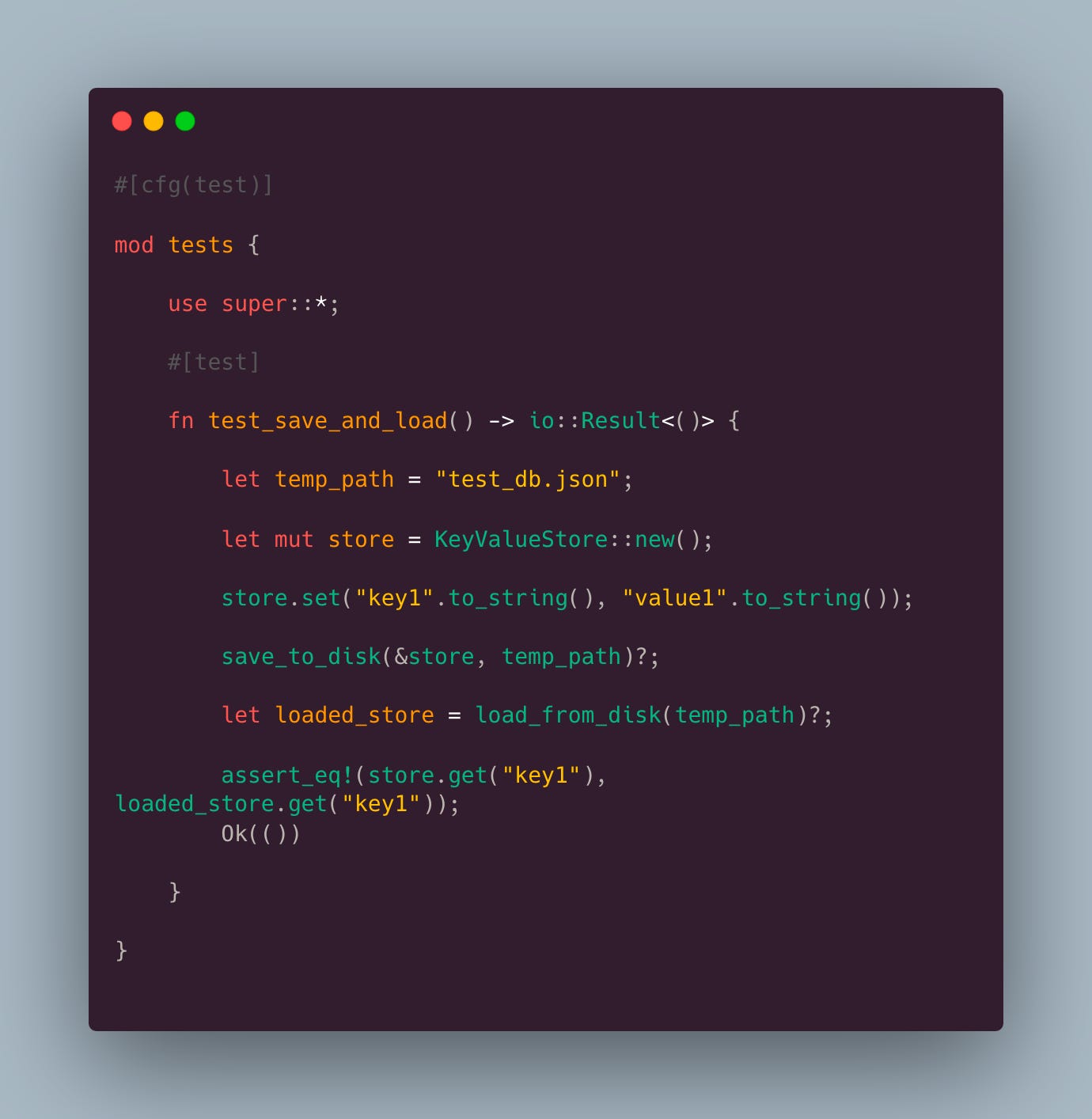
Building this persistence feature into our Rust-based key-value store is like a rite of passage. It's where our program stops being a mere toy and starts being something that can hold its own in the world, much like a startup taking its first steps into the market. It’s a manifestation of an architecture that thinks ahead, bakes in resilience, and acknowledges growth—a store that does not just exist momentarily but persists, adapts, and flourishes over time.
Finishing Out
We began with a simple idea—quickly storing and fetching data—and turned it into a functional, reliable tool.
Throughout the project, we concentrated on Rust's strengths. Its guaranteed memory safety without a garbage collector, and its handling of concurrent operations with ease, established our store's solid foundation. Here's how we encapsulated the key-value store functionality in Rust:
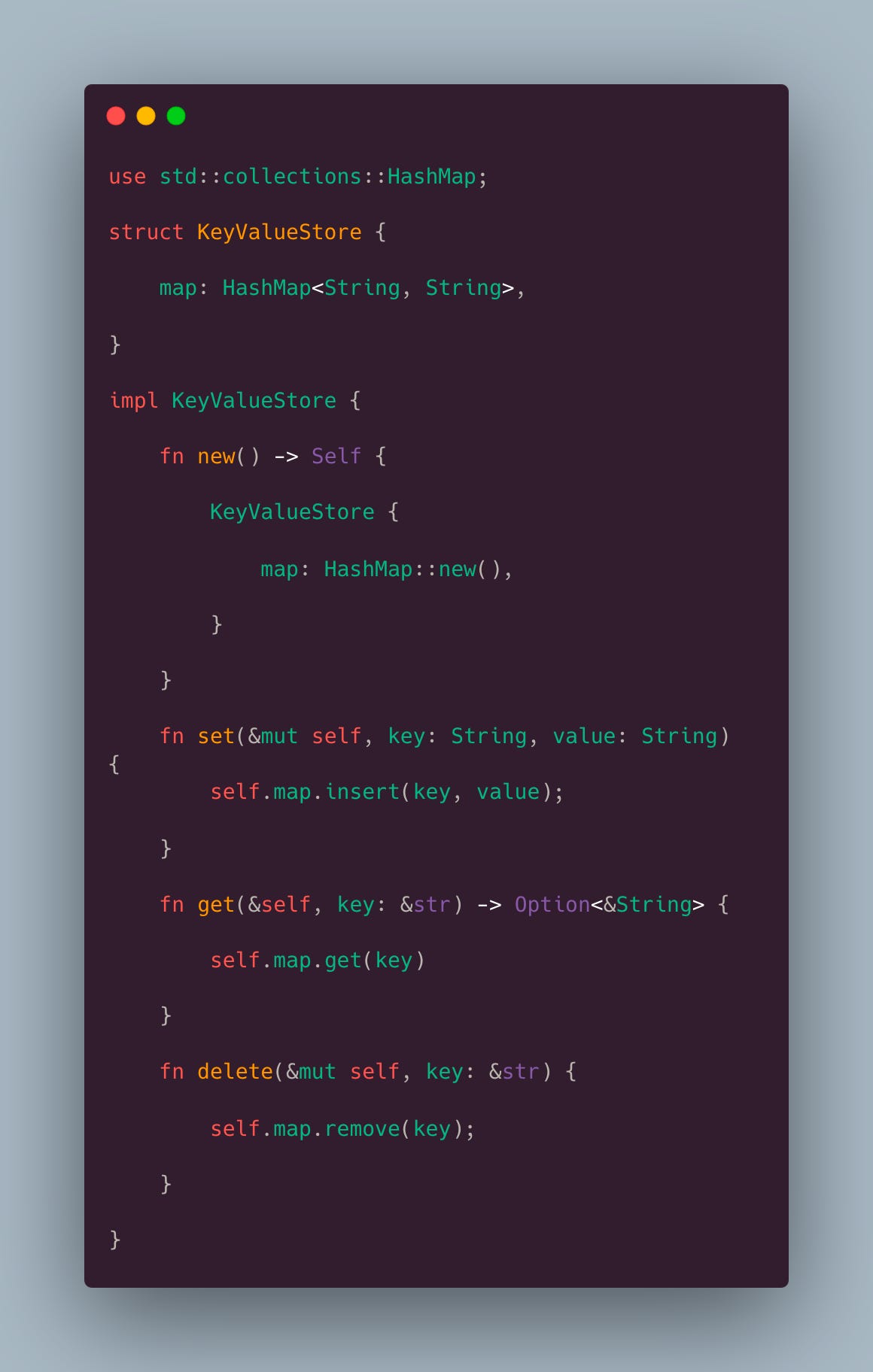
Rust delivered not only on the promise of performance but also endowed our project with the confidence that comes from its strict type system and ownership model. We wrote code and executed tests without the omnipresent fear of memory leaks or data races endemic to system programming.
Some future expansions could include:
1. An additional command, `KEYS`, to list all keys held in the store, could be as straightforward as this:
impl KeyValueStore {
// ... existing code
fn keys(&self) -> Vec<&String> {
self.map.keys().collect()
}
}
2. Garnishing support for concurrency would empower our store to scale and handle multiple users—Rust's fearless concurrency guarantees that shared resources are managed smartly.
3. For larger datasets, we might explore optimizations such as sharding our data or layering in caching mechanisms. Performance benchmarking would guide this endeavor, using tools like `criterion.rs` to gauge improvements empirically.
Our project isn't solely a lesson in Rust or key-value stores; it's about the application of new tools to solve age-old problems.