
Palindrome problem
Another classic leetcode solved in Rust

Palindrome detection is a perfect little project to strut Rust's strengths—string manipulation and Unicode handling. A string in Rust isn't just a simple strip of ASCII; it's UTF-8, nesting a wealth of languages and emojis in a uniform encoding scheme. That's where you meet complexity head-on.
A simple starter might look like this:
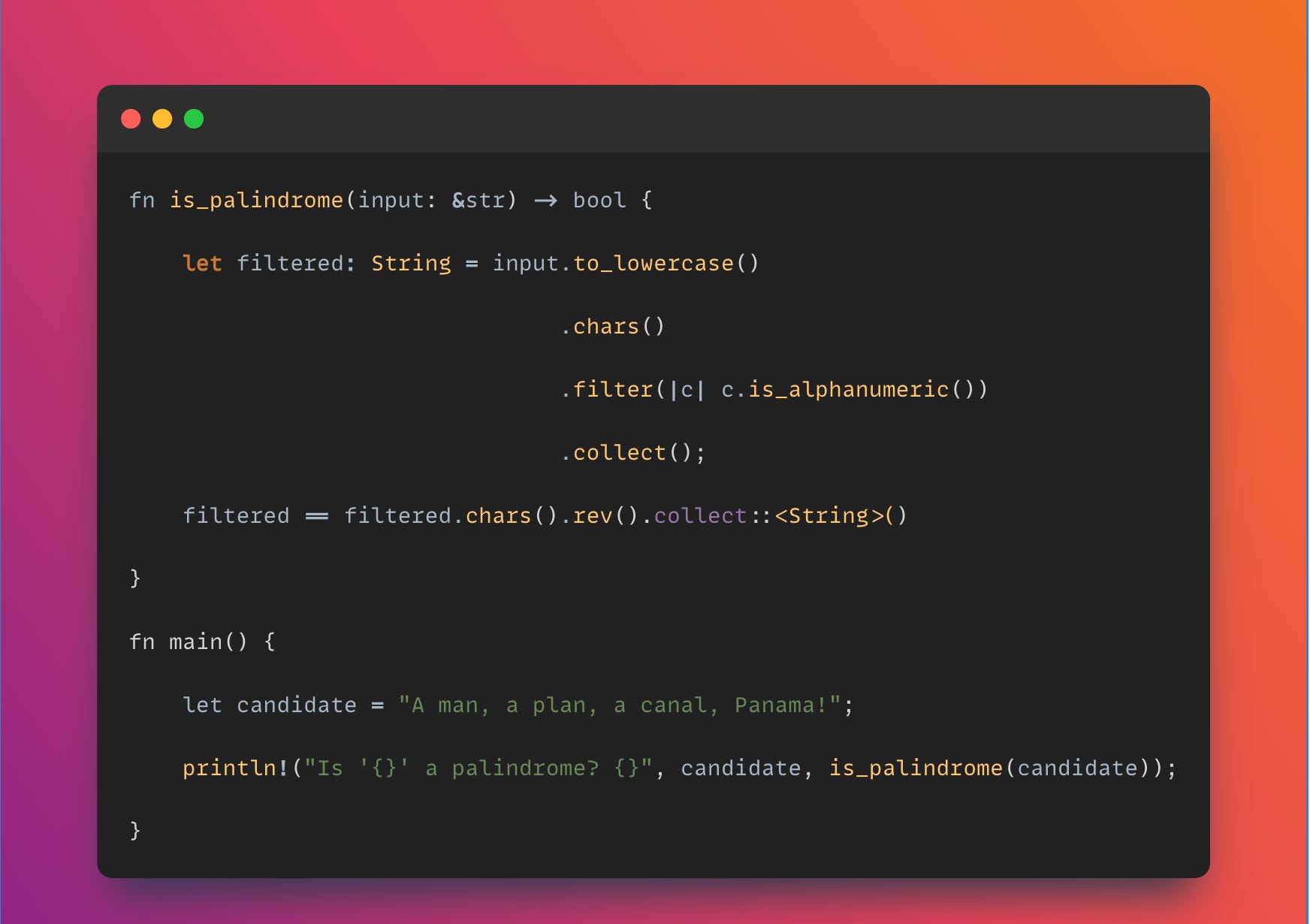
This bit of code is Rust in the embryonic stage. It takes a string, sanitizes it to ignore all but the alphanumeric characters, smothers case sensitivity, and then checks whether it reads equally from both ends.
Diving Deeper
A more dependable approach is to compare start and end characters of a string, working your way to the middle. It's key to inspect every nook and cranny for hidden oddities—non-alphanumeric characters and varying letter cases can often lead you astray. The code skeleton could be as simple as a function which returns a boolean value indicating if the input string is a palindrome:
In Rust, iterators are like trusty compasses—guiding you every step of your string traversal. Each character can be examined with `char` methods; `to_lowercase()` turns all letters into their lowercase versions, leveling the playing field of case sensitivity, while `is_alphanumeric()` filters out any distracting punctuation or spaces.
Here's how you might approach it, avoiding Rust's memory pitfalls:
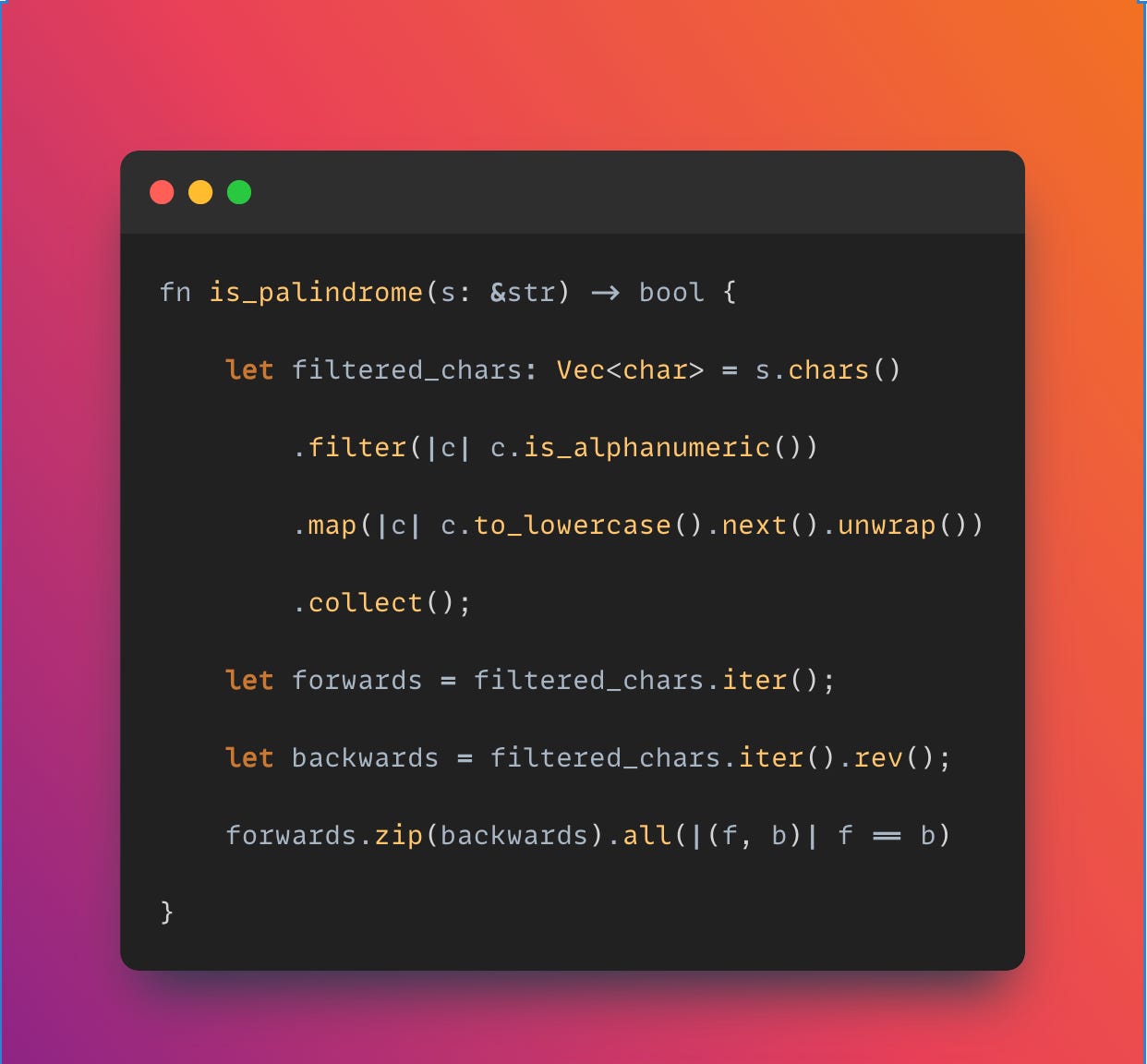
In the example, you notice `s` is taken as a string slice—Rust's way of borrowing data. Characters are filtered and converted without claiming ownership, ensuring safety. Pairing an iterator with its reverse twin and walking them together to compare each step, only if all corresponding characters match do we affirm the string's palindrome status.
When considering the performance of our palindrome-detecting Rust function, we must look at both time and space complexity. The function's time complexity is O(n/2), effectively halved since we only need to iterate halfway through the string—each step compares two characters, working towards the string's center. For a very long string, the efficiency gained by avoiding needless comparisons is significant.
Space complexity is equally important. Rust shines here, handling memory efficiently by using borrowing and ownership. This means our function uses little additional space beyond the input string itself. Languages with less stringent memory management might require duplicating strings or characters, incurring a greater memory footprint.
Now, could our Rust code be more idiomatic? Certainly. Consider using Rust's `chars().rev()` to create an iterator that consumes the string in reverse. This helps eliminate the need for manually reversing the string, which simplifies the solution:
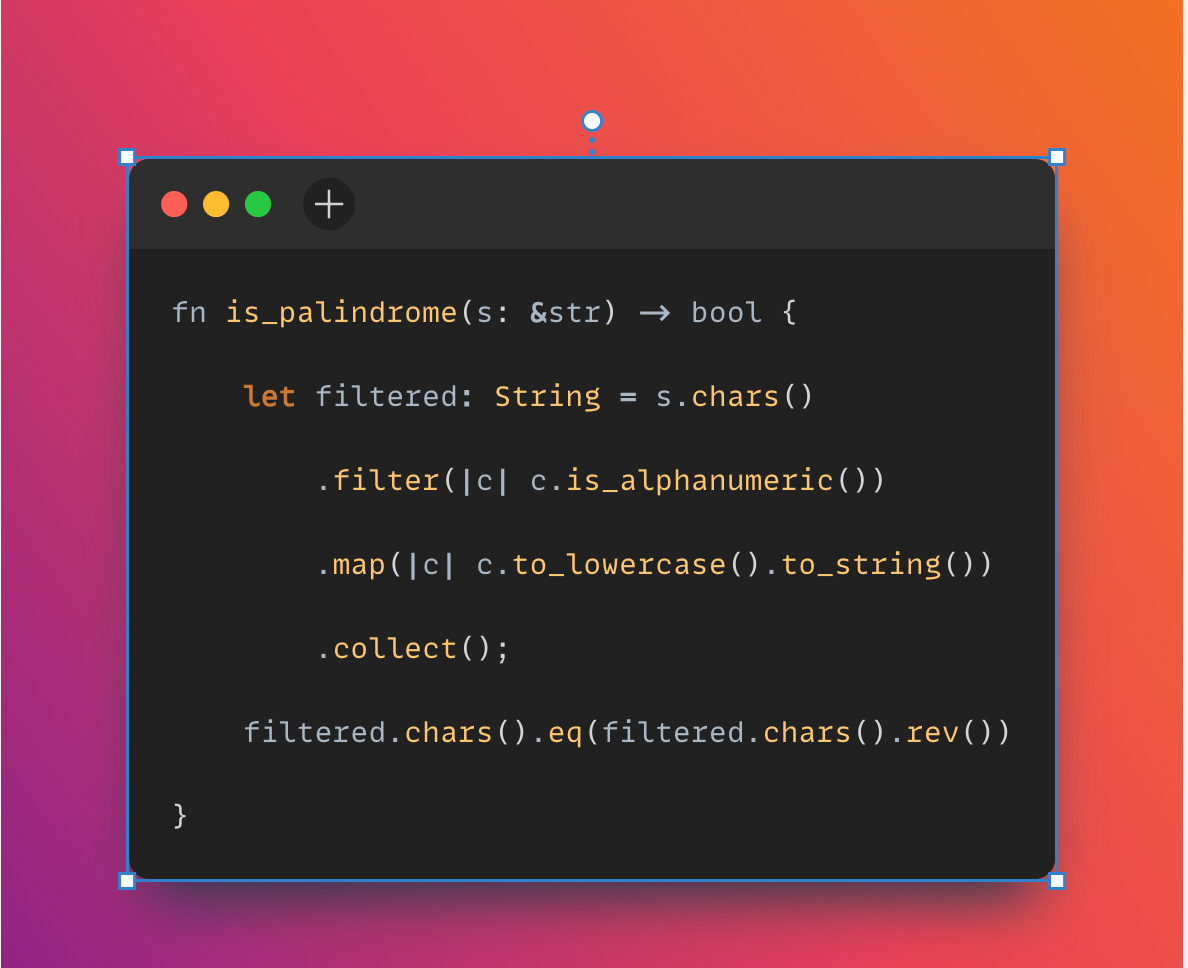
We can also extend our function to handle more complex cases like multi-line palindromes or phrases. Incorporating these would involve modifying our filter to handle newlines and whitespace appropriately.
The palindrome problem has great educational value for Rust beginners. It touches on fundamental Rust concepts without overwhelming complexity. New programmers learn about iterators, character manipulation, and Rust's approach to memory safety, which are crucial for deeper language mastery.